Just Test.
The Timeline Writes Itself.
Your toolkit, straight into the report. The Neuron CLI records every command you run, imports what your scanners produce, and streams your C2 into the engagement as it happens.
$ neuron pair
  Approve code 4F7K-92QD in your browser...
  ✓ Paired with Acme Internal Q4

$ neuron --ssh jumpbox shell
  ● Recording to Acme Internal Q4

jumpbox$ nmap -sV -oX scan.xml 10.20.0.0/24
  Nmap done: 256 IP addresses (41 hosts up)
  Import scan.xml? [y/n/a] a
  ✓ 41 hosts, 187 ports imported

jumpbox$ nxc smb 10.20.0.0/24 --shares
✓ Logged to Events- 14:02Commandnxc smb --shares
- 13:58ImportNmap: 41 hosts, 187 ports
- 13:41MythicNew callback WS-FIN-07
- 13:37EvilginxSession captured
The Testing Is Done. The Paperwork Is Not.
Two weeks of work across a jumpbox, a C2 server, and a dozen tools. Now the client wants to know what you ran, when you ran it, and from where.
So you dig through shell history that rolled over. You scp scan output off a box that is about to be torn down. You export C2 logs and paste them into a spreadsheet one row at a time.
None of that is testing. All of it delays the report. The record of what happened should be built while it happens, not reconstructed after.
Work as Normal. Neuron Keeps the Record.
SSH into the box you test from. Nothing is installed on it, and nothing changes about how you work.
Log Every Command
Work in the recording shell on your jumpbox or C2 server. Every command and its output lands on the engagement timeline, attributed and timestamped.
Turn Events into Findings
The evidence is already in Neuron. Promote the command that proved the vulnerability straight into a finding, output attached.
Report the Day You Finish
No rebuilding activity logs from shell history and C2 exports. The timeline, the evidence, and the findings are done when the testing is.
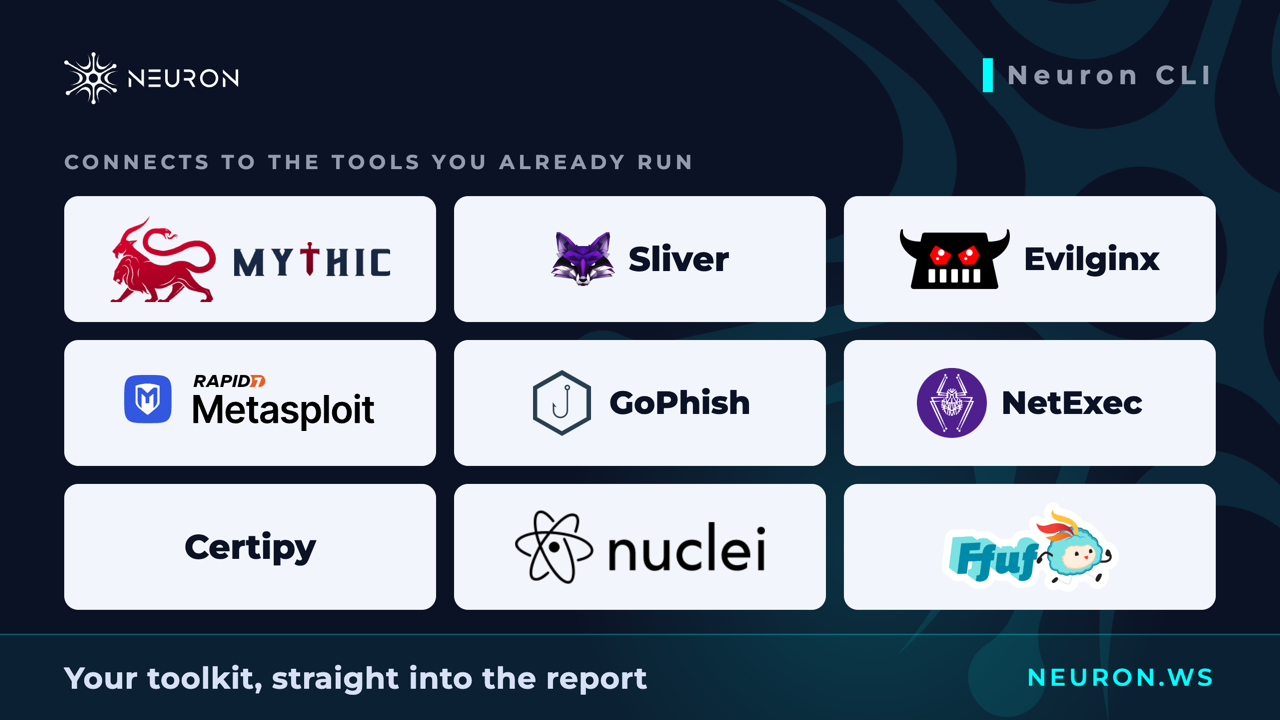
Connects to the Tools You Already Run
Collectors stream your C2, phishing, and exploitation tooling into the engagement for as long as they run. Tasks, callbacks, credentials, captured sessions, and loot land on the timeline the moment they happen.
If Neuron Imports It, the CLI Imports It
Point neuron import at any file and it picks the right importer from the content. Or put neuron in front of the tool and the results import the moment the scan finishes.
$ neuron import *.nessus burp-export.xml bloodhound.json
$ neuron nuclei -u https://app.acme.example -jsonl
$ masscan -p1-65535 10.20.0.0/16 -oX - | neuron import -One Binary. Every Engagement.
Run Tools Anywhere
Add --ssh and a host to run any tool on another box. Your own SSH config, agent, and jump hosts apply. Results import as if the tool ran locally.
File Share, From the Shell
neuron copy moves loot and configs between the box and the engagement File Share. neuron sync pushes your latest edits back down.
Export Lists to Feed Tools
Write in-scope hosts, open ports, subnets, web apps, or people out as plain text, one per line, ready for the next tool.
Updates From Your Own Server
Every build comes from your Neuron server. The CLI never reaches out to the internet to install or update itself.
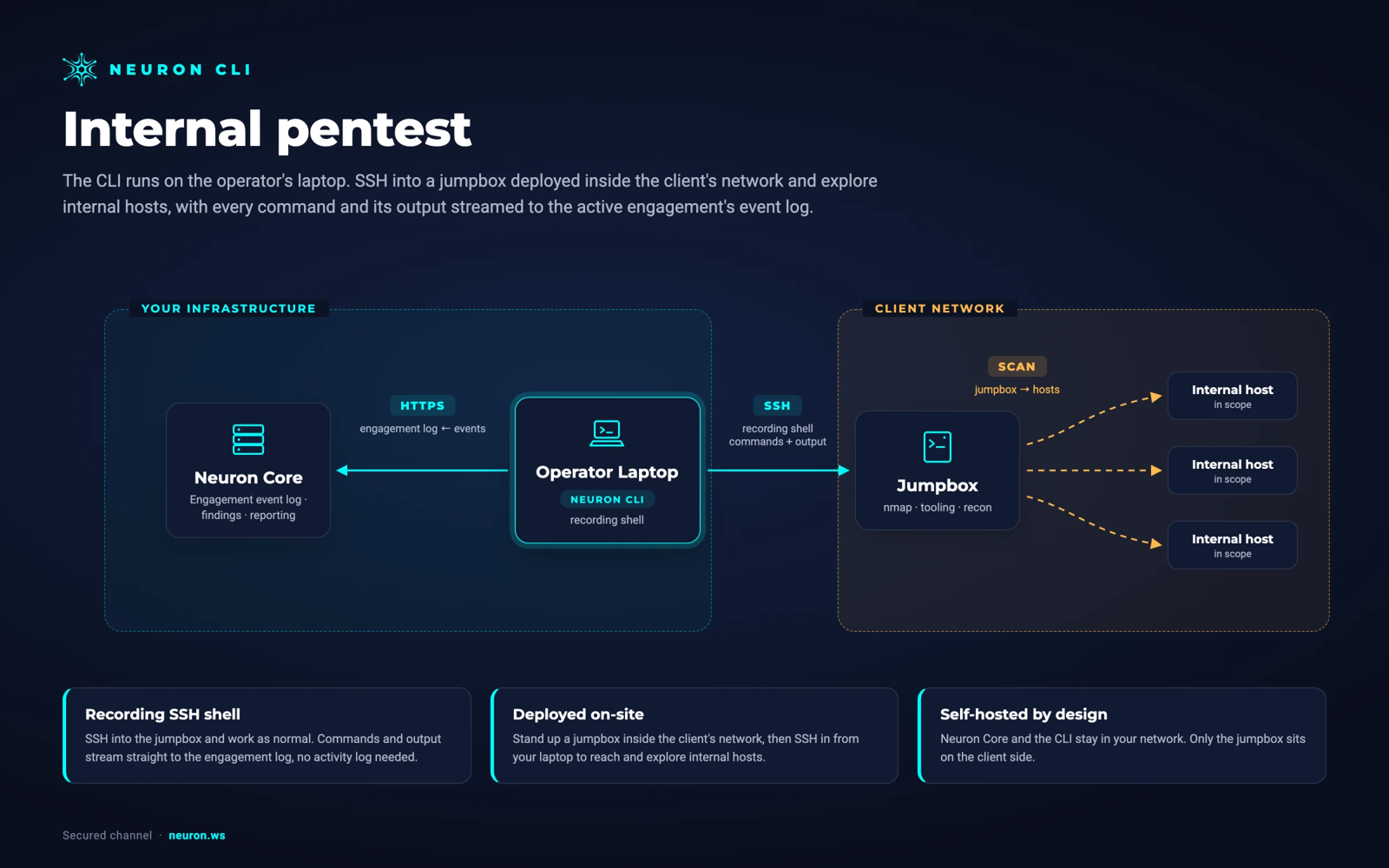
Drop a Jumpbox. Keep the Record.
Stand up a jumpbox inside the client's network and SSH in from your laptop. Every scan, every command, and every result streams to the engagement. Only the jumpbox sits on the client side. Neuron and the CLI stay in your network.
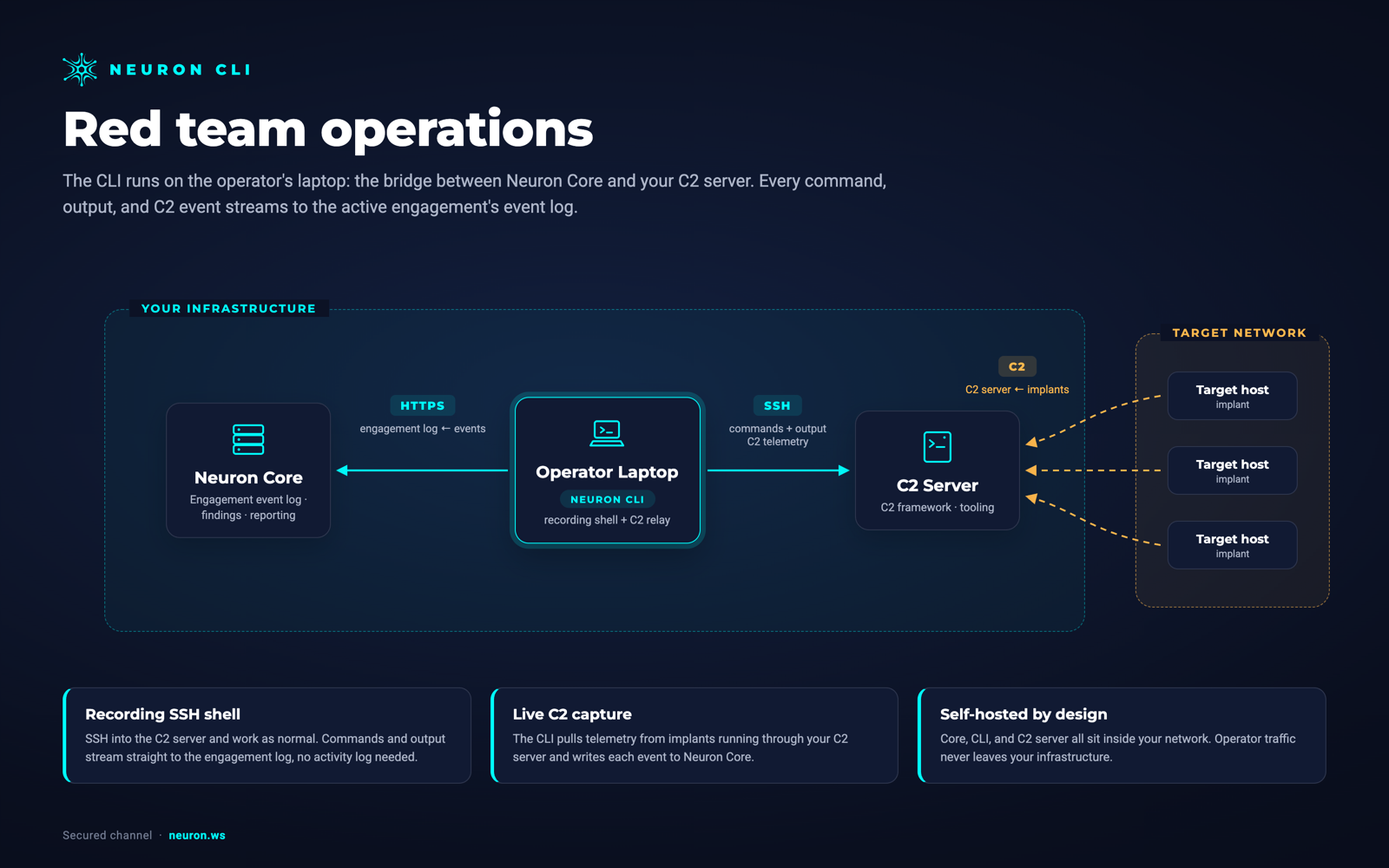
Your Infrastructure. Your Timeline.
The CLI runs on the operator's laptop, the bridge between Neuron and your C2 server. Neuron, the CLI, and your C2 all sit inside your network. Operator traffic never leaves your infrastructure.
More Feature Spotlights
Playbooks
Run your methodology against an assessment and track coverage as the work happens. OWASP WSTG, PTES, NIST 800-115, or your own.
Retests
A retest as a record. Independent dates, scope, ownership, and evidence trail per round.
Echo Up
Drop files onto a target box from just the shell you already have. Bash, CMD, or PowerShell.
Track Changes
Inline track changes on findings and briefs, attributed and timestamped. Approval blocked until resolved.
Briefs
The library for executive summaries, scope, and methodology. AI first pass on your engagement data.
Engagement Scheduling
The schedule lives where your engagements live. Drag to move, drop to reassign.
Findings Library
AI that pulls from your team's approved library instead of generating from scratch.
AI Reporting
On-premise AI for pentest reporting. Inference stays inside your network.
QA Pipeline
Finding-level QA built into the engagement workflow.
Workflow Integrations
Push findings into Jira and ServiceNow.
Collaborative AD Graphing
Multiple testers on one AD attack graph.
AD Attack Paths
Per-engagement AD datasets and attack graphs.
Ready to Transform Your Security Practice?
See how Neuron helps security teams replace fragmented tools with a single platform for offensive security, bringing structure, visibility, and consistency to every engagement.
Platform